


PISA 2025 Singapore Results: What They Actually Mean for Your Child
The OECD released the PISA 2025 results on 8 September 2026. Singapore came first in the world in reading and second in mathematics, science and computational problem solving. The rankings made the headlines. The more useful part of the report is what it says about how our children are learning, and one finding in particular that most coverage skipped.
What PISA actually tests
PISA is the OECD’s Programme for International Student Assessment. It is run every three years on 15 year olds, which in Singapore means students in Secondary 3 and Secondary 4. The 2025 round was the largest yet, with more than 760,000 students across 91 countries and economies taking part. In Singapore, 6,551 students from 157 schools sat the assessment, representing roughly 42,500 fifteen year olds.
The important thing about PISA, and the reason it matters more to parents than a league table suggests, is that it does not test whether a student has memorised a syllabus. It tests whether they can take what they know and apply it to a situation they have never seen before. The 2025 questions asked students to model how exercise affects fitness for astronauts in low gravity, and to program a robotic claw to sort objects at a recycling plant. There is no formula to recall. There is only reading the problem properly, working out what is being asked, and choosing an approach.
How Singapore performed in PISA 2025
| Domain | Singapore score | World rank | OECD average |
|---|---|---|---|
| Reading | 535 | 1st | 461 |
| Mathematics | 563 | 2nd | 463 |
| Science | 560 | 2nd | 482 |
| Computational problem solving | 563 | 2nd | 500 |
Source: OECD PISA 2025 Results (Volume I), Singapore country note. Reporting by The Straits Times and CNA.
A note on the maths ranking, because it is being read wrongly in a few places. Singapore topped all three core domains in 2022. In 2025 it sits second in maths behind the four Chinese provinces of Beijing, Shanghai, Jiangsu and Zhejiang, which score as a single system. Those provinces had no published results in the 2022 cycle. This is the first time in seven years that the two appear in the same table. Singapore’s maths performance did not collapse. The table simply has one more entry in it.
Two figures from the OECD report are worth more than the rank. Thirty seven per cent of Singapore students reached Level 5 or 6 in mathematics, the top two proficiency bands, against an OECD average of eight per cent. And fifteen per cent were academic all rounders, meaning top performers in reading, mathematics and science at the same time. That is the highest proportion of any participating system, against an OECD average of three per cent.
The new domain: computational problem solving
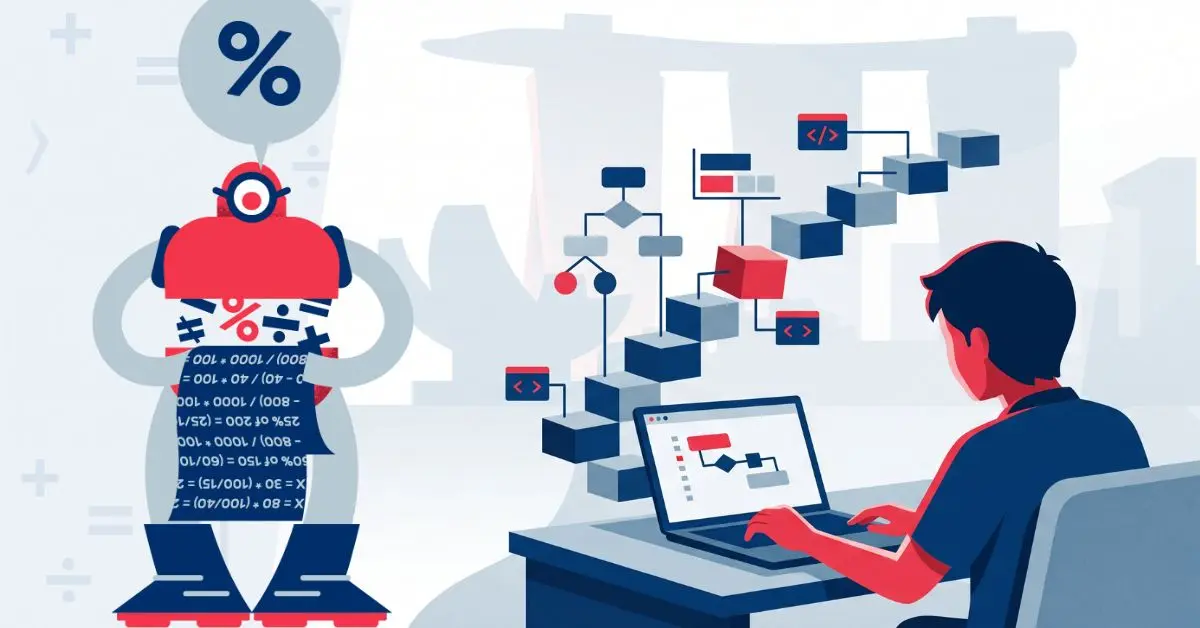
PISA 2025 introduced a domain that had never been assessed before. Computational problem solving looks at whether students can use digital tools and computational thinking to work through problems that have no obvious single answer. Building and debugging a solution. Running an experiment and analysing what comes back. Breaking something messy into steps a machine could follow.
Singapore placed second in the world. According to the Ministry of Education, more than half of Singapore students were top performers in this domain, compared with about a quarter of students across OECD countries.
Parents sometimes read “computational” as “coding” and assume this belongs in an enrichment class with robots on the table. The PISA report addresses that directly, noting that many parents still treat computer science as a specialist subject useful mainly to future software engineers, and calling that a mistake. What the domain actually rewards is the ability to look at an unfamiliar problem, decide what matters, break it into ordered steps, try something, check whether it worked, and adjust. Those are problem solving habits. They happen to be the same habits a good maths lesson builds, which is why the result sits alongside the strong maths and reading scores rather than separately from them.
The finding most coverage skipped
Buried well below the rankings in MOE’s release is the result that should matter most to a parent reading this.
Singapore students see their families as less involved in their learning than students in almost every other system.
About 49% reported a weekly family conversation about how they were doing at school, against an OECD average of 60%. Only 39% said their family takes an interest in what they are actually learning, against an OECD average of 58%. Both figures have fallen since 2022.
Read that gap carefully, because it is not a scolding. Singapore parents are, if anything, unusually invested in their children’s education. What the data suggests is that the investment goes into arranging the learning, the classes, the materials, the schedule, rather than into talking with a child about the learning itself. Those are not the same thing, and PISA can tell the difference.
MOE has pointed families toward the Parenting for Wellness resources developed with the Health Promotion Board and the Ministry of Social and Family Development. The smaller version is easier to start tonight. Ask what your child worked on today rather than how they did. Ask them to explain one question to you and let them be the one who knows. It costs five minutes and it is the single lowest effort intervention in the entire report.
One more finding worth sitting with. Twenty three per cent of Singapore students reported doing no exercise at all outside school, against an OECD average of 17 per cent.
What Singapore students told PISA about themselves
The attitude data is genuinely encouraging, and it complicates the tired story about pressure and rote learning.
- 88% said they enjoy solving problems, against an OECD average of 80%.
- 88% said they would try on their own before asking for help, against an OECD average of 78%.
- 78% said they compare different sources when searching for information online, against an OECD average of 64%.
- 96% said they feel safe in their classrooms.
- Singapore also ranked second in the new environmental science module, with 27% reaching the top two proficiency levels against an OECD average of 7%.
Commenting on the findings, MOE’s Director-General of Education, Ms Liew Wei Li, said the results show Singapore students are “curious, they persevere even when learning gets hard”, and that they care about the world around them.
What this means for how your child learns maths
Put the four findings side by side and a picture forms. Singapore children are strong readers. They are strong at applying mathematics to unfamiliar situations. They are willing to sit with a hard problem rather than give up on it. And the part of their learning most likely to be thin is the conversation at home about what they are actually thinking.
That maps almost exactly onto what we see in a classroom. The child who struggles with a Paper 2 problem sum very rarely has a comprehension problem. They can read every word. What breaks down is holding the sentences together while turning them into something they can work with. By the third line, the first line has gone.
It is why our word problem reading method, ACEit, takes a problem one sentence at a time and turns each sentence into part of a picture before moving on. Bracket the sentence. Circle the numbers. Add to the model. Then read the next one. Reading to understand, rather than reading to reach the end.
It is also why we teach a routine for approaching any unfamiliar question, Understand, Plan, Solve, Check, and why every level moves through concrete objects, then pictures, then numbers, rather than starting at the symbol. Those are the same habits PISA rewarded in the computational problem solving domain. Read the situation properly. Break it down. Choose an approach. Check whether it holds.
Students who learn our strategies typically gain 15 to 20 marks on Paper 2, which is around one AL grade. That improvement is not the result of covering more content. It comes from being able to start a question they have never seen before. Across our PSLE students, 80% score AL1 to AL3, and more than 95% improve by at least one grade.
Oodles Math is the Sole Certified Math Tuition Partner of onSponge since 2010, and our programmes run from K2 through to Secondary 4, following the MOE syllabus topic by topic.
See how your child approaches a problem they have not met before
Book a free trial lesson at a centre near you and watch how it works.
PISA 2025 Singapore results: common questions
When were the PISA 2025 results released?
The OECD released results for science, mathematics, reading and computational problem solving on 8 September 2026. Analysis of students’ self-directed learning follows in 2027.
Where did Singapore rank in maths in PISA 2025?
Second, with a mean score of 563 against an OECD average of 463. Beijing, Shanghai, Jiangsu and Zhejiang in China scored 612 as a combined system.
Did Singapore's maths results drop?
Singapore’s own performance remains among the strongest in the world, with 37% of students reaching the top two proficiency levels against an OECD average of 8%. The change in rank reflects the participating Chinese provinces appearing in the published table for the first time since 2018.
What is computational problem solving in PISA?
A new domain introduced in PISA 2025 that assesses how well students use digital tools and computational thinking to solve real-world problems, including programming, modelling, running experiments and analysing data. Singapore placed second in the world.
Who takes PISA in Singapore?
Fifteen year olds, which corresponds to Secondary 3 and Secondary 4. In 2025, 6,551 students from 157 schools took part, representing about 42,500 students.
What can parents do with these findings?
The clearest action point in the report is family conversation. Fewer than half of Singapore students reported a weekly discussion at home about school, and only 39% felt their family takes an interest in what they are learning. Asking a child to explain one thing they worked on today addresses the exact gap the data identifies.
Sources
All figures in this article are drawn from the following published sources.
- Ministry of Education, Singapore. PISA 2025: Singapore Students Demonstrate Strong Real-World Problem-Solving Skills in Computational Thinking Domain, press release, 8 September 2026. https://www.moe.gov.sg/news/press-releases/20260908-pisa-2025-singapore-students-demonstrate-strong-real-world-problem-solving-skills-in-computational-thinking-domain
- OECD. PISA 2025 Results (Volume I): Singapore country note. https://www.oecd.org/en/publications/pisa-2025-results-volume-i-country-notes_2d4ff9ea-en/singapore_80497e2f-en.html
- OECD. Student performance in PISA 2025: PISA 2025 Results (Volume I). https://www.oecd.org/en/publications/pisa-2025-results-volume-i_73451bc5-en/full-report/student-performance-in-pisa-2025_23e075c2.html
- The Straits Times. Singapore students rank top in reading, second in math and science in OECD study, by Shermaine Ang. https://www.straitstimes.com/singapore/parenting-education/singapore-students-rank-top-in-reading-second-in-math-and-science-in-oecd-study
- CNA. Singapore’s 15-year-olds second globally in using digital tools to solve complex problems: PISA, by Ang Hwee Min. https://www.channelnewsasia.com/singapore/pisa-students-computational-problem-solving-pisa-study-6367481