

Ready for the next level? A free maths problem sum check for P3, P4 and P5
Getting ready for next level maths is easier when you know what changes. Choose your child’s level, see the new topics, then try 6 problem sums at home.
Use it before the end-of-year exams to see what to revise, or after them to see what to settle before the new school year.
What is inside the full PDF
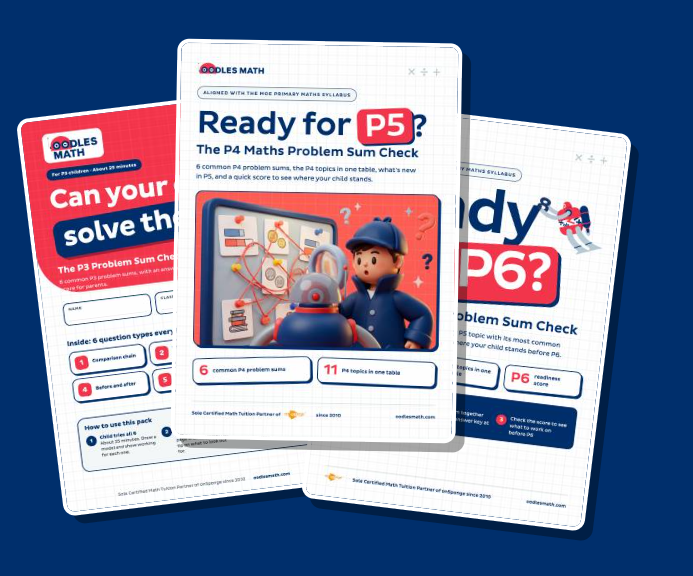
Each level has its own PDF, written for that level.
6 problem sums
The question types your child meets in exams. 20 to 25 minutes, with space for working.
Answer key
Every answer comes with one line on what to look out for.
A quick score
See if your child is ready for the next level and what to work on next.
One PDF per level
Choose P3, P4 or P5 and we send the matching check.
P3 to P4 maths: what changes in the P4 maths syllabus
P4 builds directly on P3 problem sums. These topics are new in the P4 maths syllabus.
New in P4
- Factors and multiples
- Decimals to 3 decimal places
- Mixed numbers and improper fractions
- Angles and the 8-point compass
- Symmetry
- Area and perimeter
- Line graphs
The P3 check has 6 problem sums: comparison chain, working backwards, times as many and difference, before and after, and making two amounts equal.
Try one problem sum
Vernon and Bella had the same number of T-shirts. After Bella bought another 4 T-shirts, she had 2 times as many T-shirts as Vernon. How many T-shirts did Bella have in the end?
8 T-shirts
Look out for: The question asks for Bella “in the end”, not Vernon and not at first.
P4 to P5 maths: what changes in the P5 maths syllabus
P5 brings new ideas that look different on the page. These topics are new in the P5 maths syllabus.
New in P5
- Percentage
- Rate
- Area of a triangle
- Volume
- Parallelogram, rhombus and trapezium
The P4 check has 6 problem sums, including before and after, factors and multiples, and age problems.
Try one problem sum
Jacintha had 5 times as many beads as Anne. After Jacintha used 180 beads, she had the same number of beads as Anne. How many beads did Jacintha have at first?
225 beads
Look out for: Anne is 1 unit and Jacintha is 5 units, so the 180 beads used are 4 units, not 5. The question asks for Jacintha, not Anne.
P5 to P6 maths: what changes in the P6 maths syllabus
P6 is the PSLE year. These topics are new, or now taught only in P6, in the P6 maths syllabus.
New in P6
- Ratio (now taught in P6 only)
- Average
- Algebra
- Circles
The P5 check has 6 problem sums, a table of the 12 P5 topics with the most common mistake for each, and a score to see where your child stands.
Try one problem sum
Adrian and Kingston had the same number of sweets at first. After Adrian gave away 105 sweets and Kingston gave away 49 sweets, Kingston had 5 times as many sweets as Adrian. How many sweets did each of them have at first?
119 sweets each
Look out for: Both started equal, so the gap at the end (4 units) is 105 minus 49 = 56. Find 1 unit, then add back what Adrian gave away.
Download your free Problem Sum Check
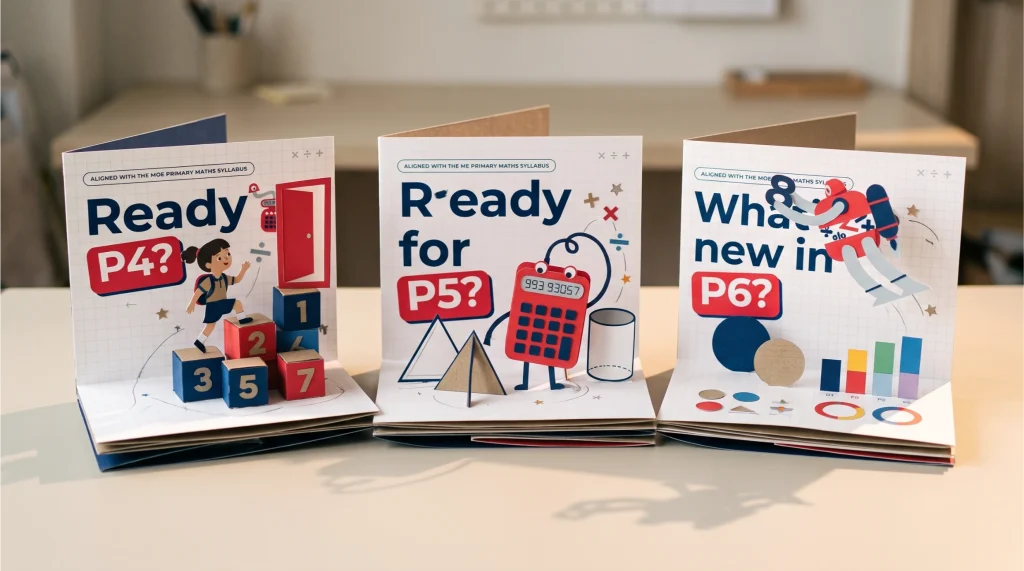
You will get the 6 problem sums, an answer key with what to look out for, and a quick score.
- 6 problem sums for your child’s level
- An answer key with what to look out for
- A quick score to see what to work on next
Please check the highlighted fields and try again.
Your details are handled under our Privacy Policy.
Questions parents ask
Dates differ by school. Most primary school end-of-year exams fall in Term 4, so check your child’s school calendar or ask the form teacher.
Formats differ by school. P3 papers are commonly 50 marks and P4 papers commonly 100 marks. At P5 there is a Paper 1 without a calculator and a Paper 2 with one. Check your school’s briefing for the exact format.
Each level above lists the new topics: P4 adds factors and multiples and decimals to 3 decimal places, P5 adds percentage and rate, and P6 brings ratio, average, algebra and circles. Your school’s briefing has the full list.
Both work. Before the exams, use the answer key to see which question types to revise. After the exams, use it to find gaps to settle before the new school year starts.
Three habits help. Read one sentence at a time. Draw before you calculate. Check the answer against the question that was asked.
Yes. The check is free to download.
See how your child learns in a free trial lesson
Oodles Math students gain +15 to 20 marks on Paper 2, about one AL grade. Book a free trial lesson and see how we teach problem sums, one sentence at a time.
Sole Certified Math Tuition Partner of onSponge since 2010