


Oodles Math | Problem walkthrough
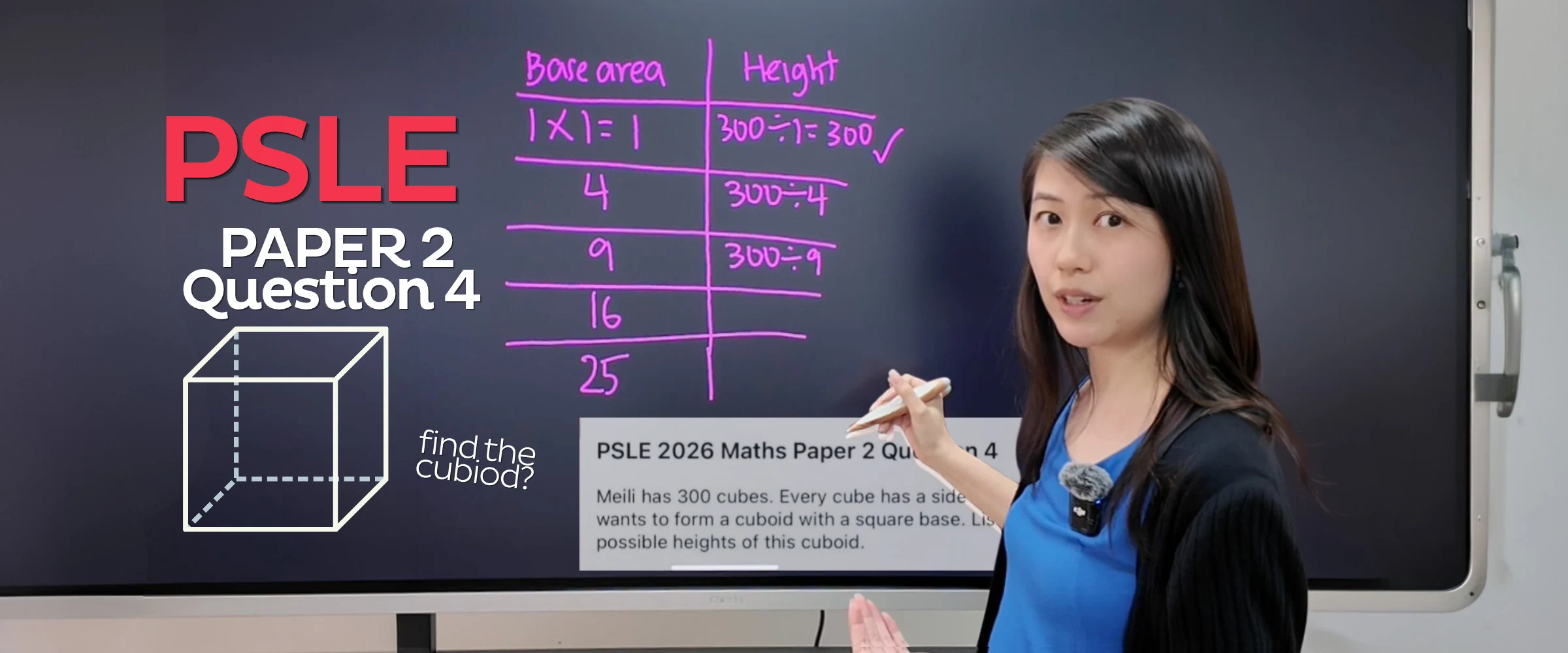
PSLE cuboid question: 300 cubes, one square base, every possible height
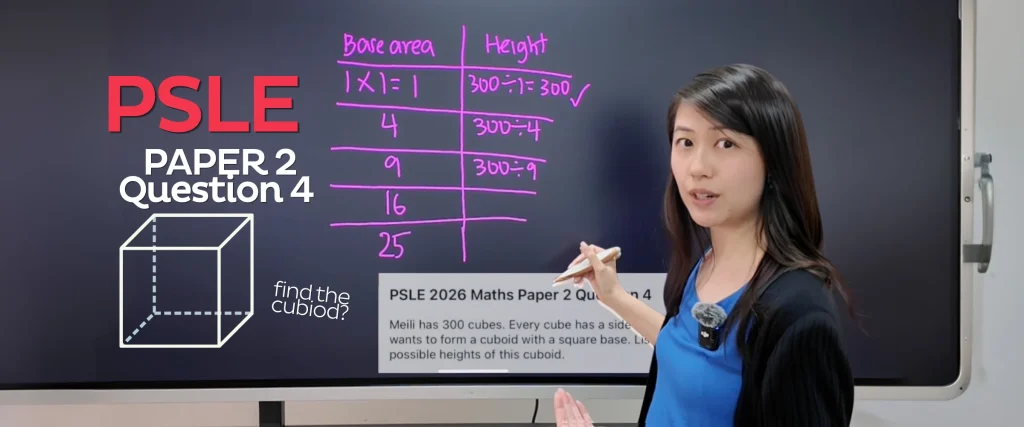
A PSLE style cuboid question that looks tricky until you see the pattern. Here is the thinking behind it, step by step.
The PSLE cuboid question below got three uncs scratching their heads on camera, and it is a brilliant one for showing what good problem solving looks like. The answer does not come from a clever shortcut. It comes from a clear routine that any child can learn.
The question
Meili has 300 small cubes, and each cube has sides of 1 cm. She wants to build a cuboid with a square base using all of her cubes. What are all the possible heights of the cuboid?
Step 1: Read slowly and pick out what matters
Take the question one sentence at a time and note what each one gives you.
- 300 cubes of 1 cm. Each cube has a volume of 1 cm³, so the cuboid has a volume of 300 cm³.
- A square base. The length and breadth are the same number.
- Every possible height. There is more than one answer, so we need a way to be sure we have found them all.
Step 2: Connect the pieces with one idea
Volume is length × breadth × height. Because the base is a square, length × breadth is simply the base area, which is a square number: 1, 4, 9, 16, 25 and so on. So:
Height = 300 ÷ base area
The cuboid is made of whole cubes, so the height must be a whole number.
Have a question? Watch the video to understand it.
Step 3: Test the square numbers in order
Now we try each possible base area and keep only the ones that divide 300 exactly.
| Base side | Base area | 300 ÷ base area | Whole number? |
|---|---|---|---|
| 1 cm | 1 cm² | 300 | Yes, 300 cm |
| 2 cm | 4 cm² | 75 | Yes, 75 cm |
| 3 cm | 9 cm² | about 33.3 | No |
| 4 cm | 16 cm² | 18.75 | No |
| 5 cm | 25 cm² | 12 | Yes, 12 cm |
| 6 cm to 9 cm | 36, 49, 64 and 81 cm² | about 8.3, 6.1, 4.7 and 3.7 | No |
| 10 cm | 100 cm² | 3 | Yes, 3 cm |
Step 4: Know when to stop
This is the part students often skip, and it is where marks are won. How do we know we do not need a base of 11 cm or 12 cm?
The base area can never be bigger than the volume. A 17 cm by 17 cm base is 289 cm², which still fits under 300, but 18 cm by 18 cm is 324 cm², which is already too big. So the largest base we ever need to check is 17 cm by 17 cm, and a quick check shows that nothing beyond 10 cm works. There is a neater way to see it too. 300 = 2 × 2 × 3 × 5 × 5, and a square base needs pairs of matching factors. We have one pair of 2s and one pair of 5s, so the possible base sides are 1, 2, 5 and 10.
Possible heights
300 cm, 75 cm, 12 cm and 3 cm
Step 5: Check the answer makes sense
Good problem solvers always look back. Multiply each pair to confirm it gives 300 cm³:
- 1 × 1 × 300 = 300
- 2 × 2 × 75 = 300
- 5 × 5 × 12 = 300
- 10 × 10 × 3 = 300
The shapes also tell a nice story: a tall thin tower of 300 cm, then a shorter and wider block, and finally a flat slab only 3 cm high.
What your child learns from this PSLE maths question
The answer matters less than the habits behind it. Reading one sentence at a time, turning the words into a clear relationship (height = volume ÷ base area), testing possibilities in an organised order and checking the result at the end are skills that carry across the whole PSLE syllabus and beyond.
That is how we teach at Oodles Math. We build understanding step by step, so that a child facing an unfamiliar question has a calm way to begin.

Thank you, SGAG
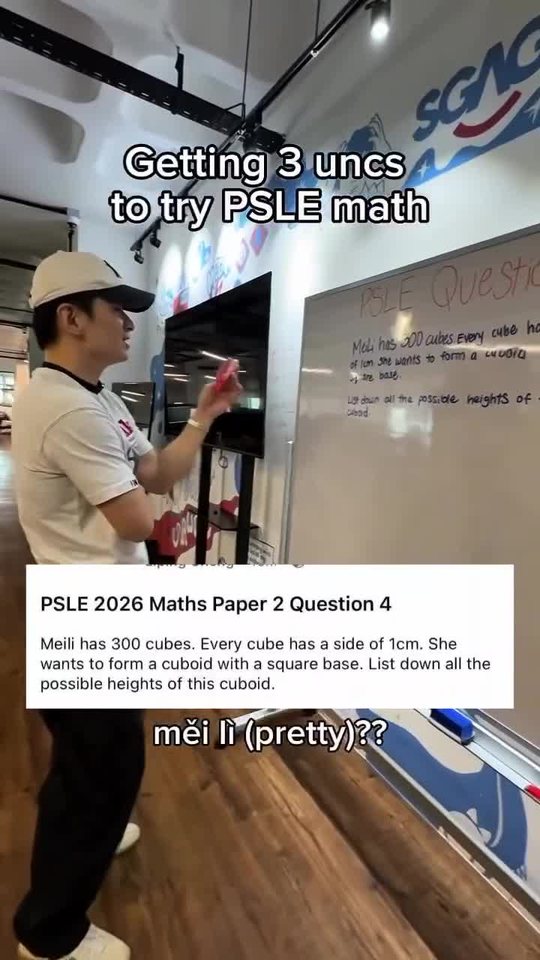
This question came to life thanks to SGAG and three very good sports: Jereld, Sean and Syak. They took on the PSLE cuboid question at the whiteboard, and the results are very entertaining.
Video and logo credit: SGAG.
Want to see how a lesson feels?
Come and watch your child discover that a hard question is only a few clear steps.