

The Screen Can Show the Answer. Only Your Child Can Build the Understanding.
Why we retired Math Quest, and how we're using technology the right way.
Hands-on maths learning is easiest to understand by watching a child at the moment a fraction finally makes sense. Very often they aren’t looking at a screen. They’re holding two halves of something, or drawing a bar and splitting it, or tapping their own working and saying, “Oh. So that’s why.” In maths, understanding usually arrives through the hands and the pencil before it settles in the head.
A thank-you to Math Quest
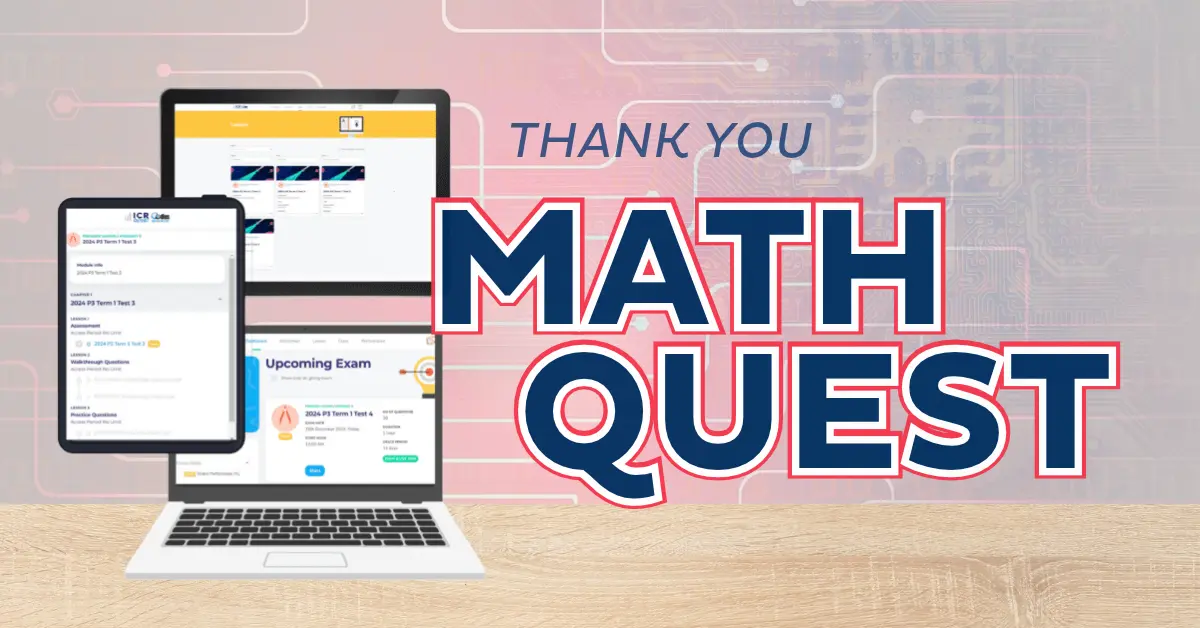
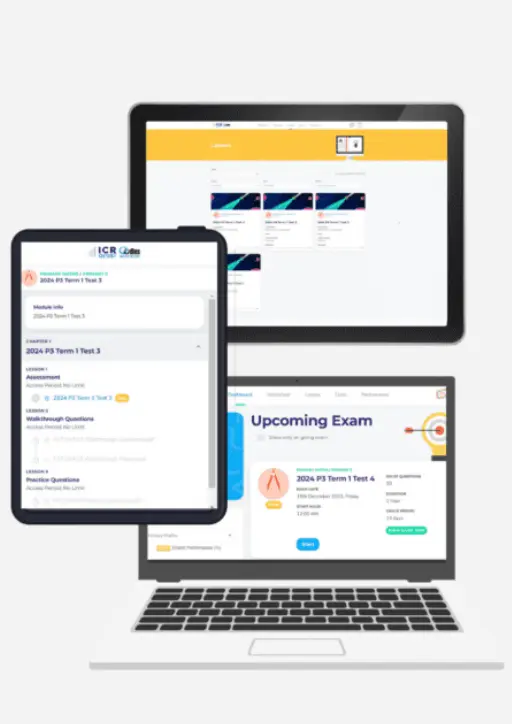
We brought digital practice into our programme before most tuition centres had one. Math Quest gave our students extra practice between lessons, and in July 2026 we retired it.
Running it taught us something important: a screen can mark an answer, but it can't see your child's working. Today we keep maths on paper, with a coach reading every step, and we use technology only where it adds something a pencil can't, like our 3D printing workshops.
Every new tool we build has to pass one test: does it make your child do more of the thinking, or less?
But we want to do even better, and the research on how children learn maths, together with what our coaches see in class every week, points in a clear direction. We aren’t turning our backs on technology. We’re making sure every tool we use serves your child’s thinking rather than replacing it.
1Why hands-on maths learning works
When researchers pooled 55 studies comparing lessons that used physical objects with lessons that used only written symbols, the hands-on lessons came out ahead. The clearest gain was in how well children remembered what they’d learned, and the benefit was strongest when a teacher deliberately linked the objects to the numbers.
That linking matters. Studies of what researchers call “concreteness fading” found that children who began with real objects, then moved step by step to pictures and finally to symbols, handled new and harder problems better than children taught with objects alone or symbols alone. In Singapore maths we know this progression as Concrete, Pictorial, Abstract, and it runs through every Oodles lesson from Math Literacy to PaceUP.
Even small movements count. Children taught to gesture through an equation with their hands grasped the idea more deeply than children who simply moved number tiles around. Preschoolers who played a simple numbered board game for a few short sessions showed clear gains in number sense. And spatial skills, the ability to picture shapes and turn them in the mind, can be trained, with gains that last.
2Paper changes how deeply we read
A review of 54 studies involving more than 170,000 readers found that people understood informational text better on paper than on screen, and that the gap widened when time was limited. A Paper 2 word problem is exactly that kind of text, read against the clock.
Early brain research also suggests that writing by hand engages more of the brain’s memory-related networks than typing does. The science is still developing, but it fits what teachers have long observed: the pencil slows a child down in a useful way.
This is why we keep maths on paper. When your child reads a word problem, marks the key information with a pencil and draws a model as they go, they are reading to understand, rather than reading to finish.
3When a tool does the thinking, the learning goes with it
The newest research on AI makes the point sharply. In a study of nearly a thousand high school maths students, those given a ChatGPT-style assistant did much better during practice. When the assistant was taken away, they did worse on the test than classmates who had never used it. A version designed to give hints rather than answers largely avoided that drop.
The OECD’s 2026 review of AI in education reached the same conclusion across many studies: a tool can lift how well a student performs a task without lifting what the student actually learns.
Learning scientists have a name for why. The effort of recalling, working something out, and getting it wrong before getting it right is what makes knowledge stick. Robert and Elizabeth Bjork call these “desirable difficulties”. Manu Kapur, whose research on productive failure began in Singapore classrooms, showed that students who wrestle with a problem before being taught learn the concept more deeply. Take the struggle away, and you take away the part that builds understanding.
4The working is where the learning lives
In maths, the working is the learning. It’s also where method marks live. Most digital practice can check whether a final answer is right. It can’t see how your child got there.
Two children can write the same correct answer with very different understanding. A child with the wrong answer may be one small step from getting it. A coach looking over your child’s shoulder can see that in seconds. That’s why every Oodles lesson has a “You Do, I See” moment: your child tries a question on their own while the coach walks the room, catching misconceptions the same day, while they’re still small.
The international picture backs this up. PISA 2022 found that students distracted by devices in maths lessons scored noticeably lower, and UNESCO’s global review of technology in education concluded that digital tools should support face-to-face teaching, never replace it.
5Singapore is finding its balance too
None of this is anti-technology, and neither are we. MOE describes its own approach as a “goldilocks” balance: devices used with purpose, at the right age, in the right amount. From January 2026, secondary school students keep their phones stored for the whole school day. Sweden, once one of the most digital school systems in the world, has invested heavily in bringing printed textbooks and handwriting practice back into its classrooms.
The direction is clear. Technology has a place in learning, and the child’s own thinking stays at the centre.
6Technology, used the right way
Being at the forefront of learning doesn’t mean putting more screens in front of children. It means knowing exactly where technology adds something a pencil can’t, and using it there.
Our 3D printing workshops are a good example. Your child designs a shape on screen, prints it, and then holds the result in their hands. The volume, the faces and the measurements they worked out become something they can turn over, check and talk through with a coach.
The technology serves the making, and the understanding still comes from your child’s own hands and head. Research on spatial skills backs this up: children who build and handle shapes get better at reasoning about them, and those gains last.
7What this means for your child
At Oodles Math, your child will spend most of their time doing maths with real objects, with a pencil, and with a coach who reads their working. Our worksheets and problem-solving strategies were always designed to be done by hand, and that’s where we’re putting our energy.
We will keep developing tools that help our students learn, and we intend to do more of this, not less. Every one of them will have to pass a single test.
Does it make your child do more of the thinking, or less?
The moment of understanding belongs to your child. Our job is to protect it.
See it for yourself
Book a free trial class and watch how your child learns with their hands, a pencil and a coach beside them.
Book a Free TrialThe research behind this post
- Carbonneau, Marley and Selig (2013), teaching maths with concrete manipulatives
- Fyfe, McNeil, Son and Goldstone (2014), concreteness fading
- Novack and Goldin-Meadow, gesture and maths learning
- Siegler and Ramani, number board games
- Uttal et al. (2013), the malleability of spatial skills
- Delgado et al. (2018), reading on paper vs screen
- Van der Weel and Van der Meer (2024), handwriting and brain connectivity
- Bastani et al., generative AI and learning in high school maths
- OECD Digital Education Outlook 2026
- Bjork and Bjork, desirable difficulties
- Kapur, productive failure
- OECD, PISA 2022 results
- UNESCO GEM Report 2023, technology in education
- MOE, views on digital devices and purposeful screen use
- MOE (Nov 2025), enhanced measures for healthier screen use
- AP, Sweden brings back books and handwriting