


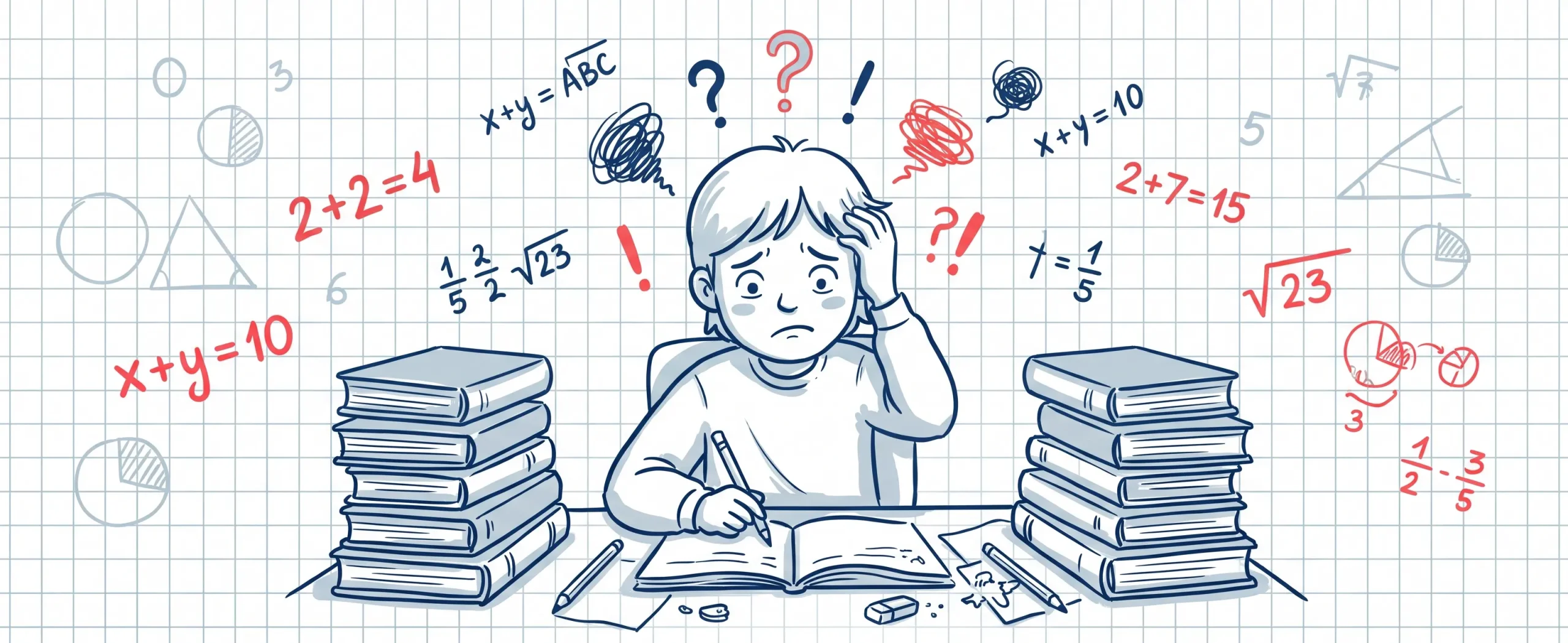
Maths Anxiety in Children: What Singapore Research Says and How to Help
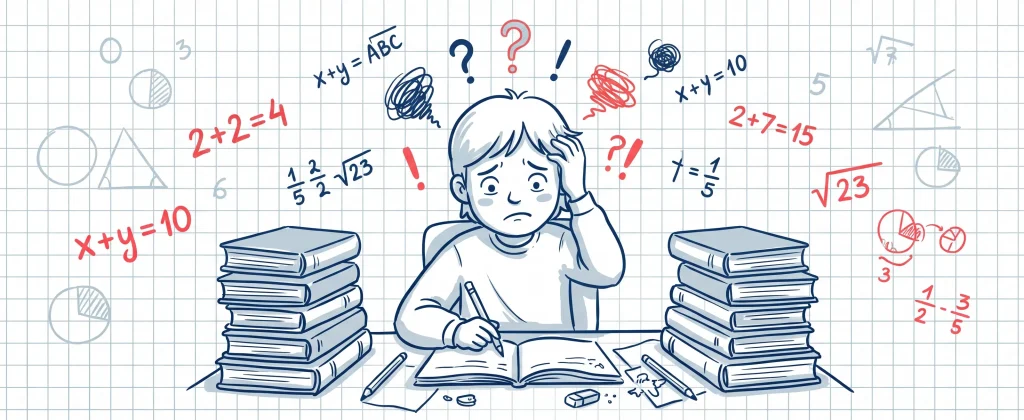
Key takeaways
- Maths anxiety is linked to lower maths scores in every education system the OECD measured in PISA 2022.
- About 35% of Singapore 15-year-olds say they get very nervous doing maths problems, below the OECD average of 39%.
- Anxiety uses up working memory, which is why anxious children often struggle most with word problems.
- Calm routines, understanding over memorising, and steady parental support all help.
What is maths anxiety?
How common is maths anxiety in Singapore?
At a glance
Anxiety and maths in Singapore
35%
of Singapore 15-year-olds get very nervous doing maths problems
OECD average: 39% · PISA 2022
9.3%
of children aged 8 to 12 had clinically elevated anxiety symptoms
Nearly 1 in 10 · study of 1,655 children
1 in 3
teens aged 10 to 18 reported symptoms such as anxiety or low mood
NUS YEAR study · 3,336 young people
But only about 1 in 10 parents had noticed signs of distress in their child.
Students who get very nervous doing maths problems
Source: OECD PISA 2022. Bars are drawn on a 0 to 100% scale.
Why anxiety affects maths results
A child who says “I understand the words, but I don’t know how to start” is rarely short of ability. More often, they need a calm, step-by-step way in.
Signs of anxiety in children to look out for
- Physical complaints such as stomach aches, headaches or a racing heart, especially before tests or on school mornings.
- Avoidance, like delaying homework, “forgetting” worksheets or asking to skip school on test days.
- Going blank on topics they could do at home.
- Harsh self-talk, such as “I’m stupid” or “I’ll never get this”.
- Tears or anger at homework time that seem bigger than the task.
- Sleep changes or tiredness in the run-up to exams.
What fuels exam stress and PSLE stress
What a test seems to represent
Adult stress at home
Learning by memorising
Screens and sleep
How to help your child with exam stress and maths anxiety
8 ways to help at home
- 01
Listen before you reassure
Swap "There's nothing to worry about" for "That sounds hard. Which part feels hardest?"
- 02
Praise effort, not just marks
Notice when your child tries a second method or checks their work.
- 03
Break it into small steps
"Three fraction questions" is easier to start than "revise maths".
- 04
Practise a calm-down breath
Primary 5 pupils taught slow, deep breaths before a maths test felt significantly less anxious.
- 05
Make mistakes normal
Treat mistakes as information. Skip "I was never good at maths either".
- 06
Face it, one step at a time
Avoiding every stressful task can make anxiety grow. Support small steps forward.
- 07
Protect the basics
Enough sleep, time to play and move, and screen-free time before bed.
- 08
Stay consistently there
Children with steady emotional support from parents felt more positive about exams.
Sources: NIE (Khng, 2017); Duke-NUS and KKH clinical psychologists; Focus on the Family Singapore survey, 2020.
How Oodles Math builds calm, confident learners
- Understanding before procedures. Children learn from real objects, then pictures, then numbers, so new ideas make sense before they become symbols.
- One clear way into every problem sum. With the Oodles Math Method, your child learns to read a word problem one sentence at a time and turn it into a model they can work with, so a long question feels manageable.
- Every lesson checks understanding live. Teachers see how each child is doing during class, so a small gap is spotted and fixed early.
- Mock exams under real exam conditions. Practising in a familiar format means the real paper holds fewer surprises on the day.
- A diagnostic assessment that guides, not labels. It shows which topics need attention, so practice is focused and progress is visible.
When to seek more support
- Samaritans of Singapore (24 hours): call 1-767, or WhatsApp CareText 9151 1767
- IMH Mental Health Helpline: 6389 2222
- SAMH Helpline (weekdays): 1800-283-7019
Frequently asked questions
Maths anxiety is not a formal diagnosis on its own. It is a specific, well-studied form of worry linked to maths. For most children it responds well to support at home and in class. If the worry is severe or spreads to other parts of life, speak to a professional.
Common signs include stomach aches or headaches before maths lessons or tests, going blank on familiar topics, avoiding homework, tears or frustration at homework time, and negative self-talk such as “I’m bad at maths”.
It can start in the early primary years. Singapore research found elevated anxiety symptoms among children aged 8 to 12, and transitions such as starting Primary 1 or moving into upper primary are common pressure points.
Keep routines steady, break revision into small finished tasks, praise effort and thinking, and practise a short breathing routine before tests. Most importantly, let your child know your support does not depend on their score.
Practice helps when it builds understanding and shows progress. Endless practice on topics a child does not yet understand can increase worry. Focused practice on the right topics, at the right level, works better.
Sources
- OECD, PISA 2022 Results, Volumes I and II (maths anxiety data).
- OECD, PISA 2015 Results, Volume III: Students’ Well-Being.
- Magiati et al., Self-reported depression and anxiety symptoms in school-aged Singaporean children, Asia-Pacific Psychiatry.
- NUS Medicine, Youth Epidemiology and Resilience (YEAR) Study, April 2023.
- National Institute of Education, Test Anxiety (Dr Tan Chee Soon), 2022.
- Jamaludin et al., Low-Progress Math in a High-Performing System, The Asia-Pacific Education Researcher, 2023.
- Institute of Policy Studies, 2026 Survey on Singapore’s Education System, via The Straits Times, September 2026.
- Focus on the Family Singapore children’s survey, September 2020.
- A*STAR and NUS, Neurobehavioural links from infant screen time to anxiety, eBioMedicine, 2025.
- The Straits Times, Anxiety is the invisible disorder among kids, November 2023 (Duke-NUS, KKH and IMH experts).