

Aligned with the MOE Primary Maths syllabus
Is My Child Ready for the Next Level?
A Year-by-Year Map of Upper Primary Maths
The primary maths syllabus brings something new at the start of every year from P4 to P6, and most of it is easy to see coming. This parent’s guide walks through the three moves from P3 to P6, shows what is brand new and what simply levels up, and gives you a short checklist to tick together with your child.
The short answer
Most children are ready, and the easiest way to know is to tick a short checklist together during the holidays. Each year has a handful of brand-new topics and a handful that level up from the year before. When you know which is which, a new school year feels like a plan instead of a surprise.
The year-by-year map
Topics follow the MOE Primary Mathematics Syllabus (2021). Topic order may differ by school, so use this as a map of what each year covers.
- P3
- P4
- P5
- P6
- PSLE
New: a brand-new topicLevel up: builds on last year
Moving from P3 to P4
Numbers get bigger, fractions get fuller, and model drawing needs two or more steps.
New
- Factors and Multiples
- Symmetry
- Decimals
- Pie Charts
- Nets
Level up
- Numbers to 100 000
- Multiplication and Division
- Fractions
- Angles with a protractor
- Area and Perimeter
- Tables and Line Graphs
- Model Drawing
Try together
Simplify a fraction: 69 = 23. Then subtract across zeros: 5000 minus 1236 = 3764.
A common slip
Adding the denominators. 12 + 14 is not 26.
Moving from P4 to P5
Percentage and Rate arrive, shapes and volume take a big step, and fractions start to multiply.
New
- Percentage
- Rate
- Area of Triangle
- Volume
- Triangles and 4-sided figures
Level up
- Angles
- Fractions
- Numbers to 10 million and Decimals
Try together
Add unlike fractions: 14 + 512 = 23. Then find the breadth: an area of 48 cm² and a length of 8 cm gives 6 cm.
A common slip
Thinking a longer decimal is bigger. 0.5 is greater than 0.45.
Moving from P5 to P6
Four new topics arrive in the PSLE year: Ratio, Algebra, Circles and Average.
New
- Ratio
- Algebra
- Circles
- Average
Level up
- Fractions
- Percentage
- Volume
- Angles in composite figures
Try together
Multiply two fractions: 23 × 910 = 35. Then find 15% of $80, which is $12.
A common slip
Mixing up “of the rest” and “of the total”. 14 of the remaining money means 14 of what is left, not of the whole amount.
What the PSLE maths paper looks like from 2026
Since 2026, PSLE Maths has two papers of 50 marks each, so Paper 1 now counts as much as Paper 2.
| Paper | Questions | Marks | Time | Calculator |
|---|---|---|---|---|
| Paper 1 (Booklets A and B) | 18 multiple-choice, 12 short-answer | 50 | 1 h 10 min | Not allowed |
| Paper 2 | 5 short-answer, 10 long-answer | 50 | 1 h 20 min | Allowed |
Source: SEAB, PSLE Mathematics (0008), for examination from 2026.
How to use the readiness guides at home
Read what changes
Start with the guide for your child’s next year. It shows the new topics, the level-ups and what the paper looks like.
Tick the checklist together
Each line has an example to try. Tick what your child can do on their own, and circle the rest.
Use the holidays
A few gaps are normal. The November and December holidays are a calm time to close them before the new year starts.
One habit that helps in every year
Read a problem sum one sentence at a time and build the model as you go. We use the Oodles Math Method for every problem sum, from P3 right through to the PSLE year.
Try at home these holidays
Tables on the go
Quiz the 6 to 9 times tables for 10 minutes a day, in the car or at dinner.
Shop with money
Let your child add up two prices at the shop and work out the change.
Real clocks
Use bus and MRT timings to practise the 24-hour clock and how long a trip takes.
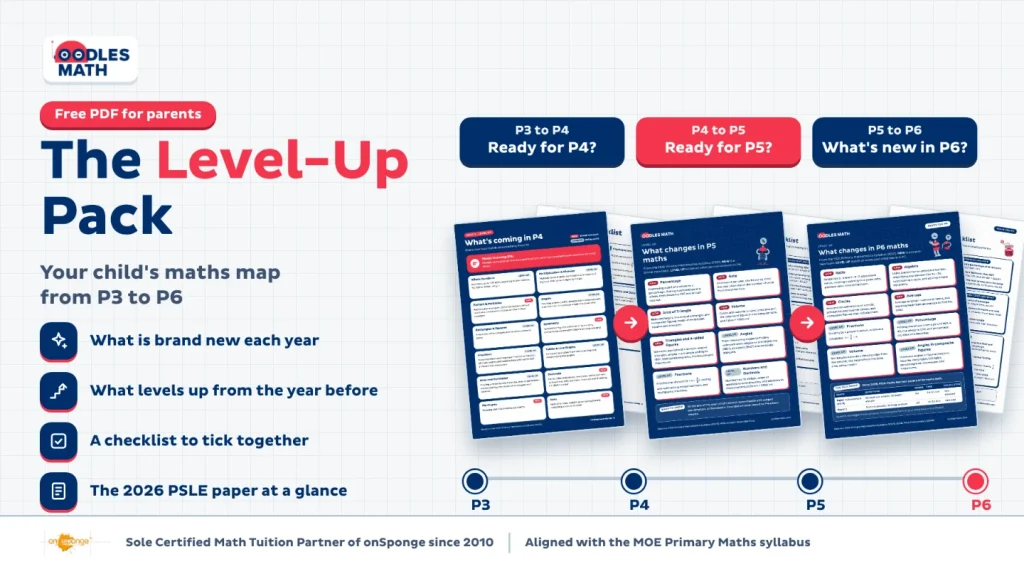
Get the Level-Up Pack
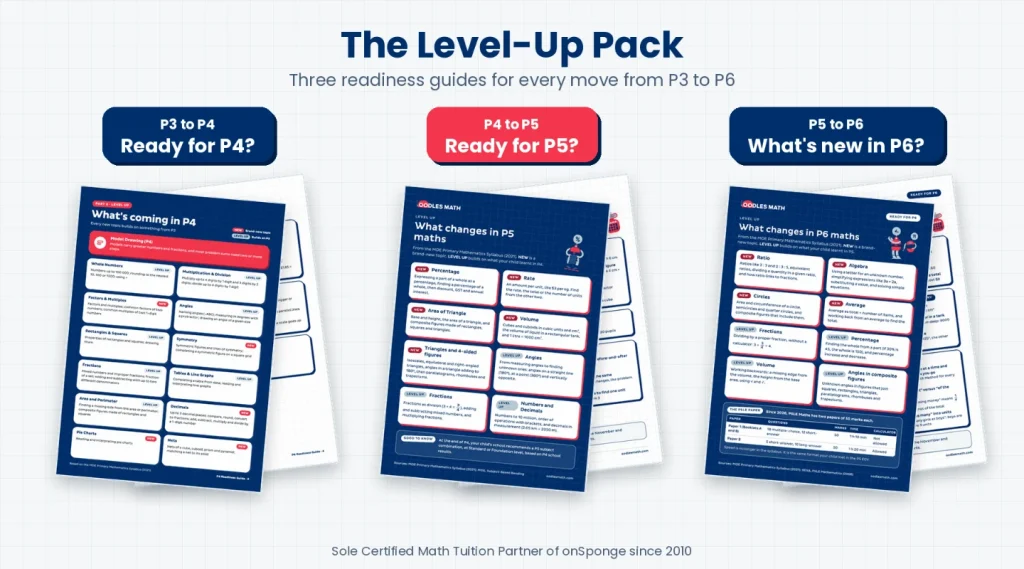
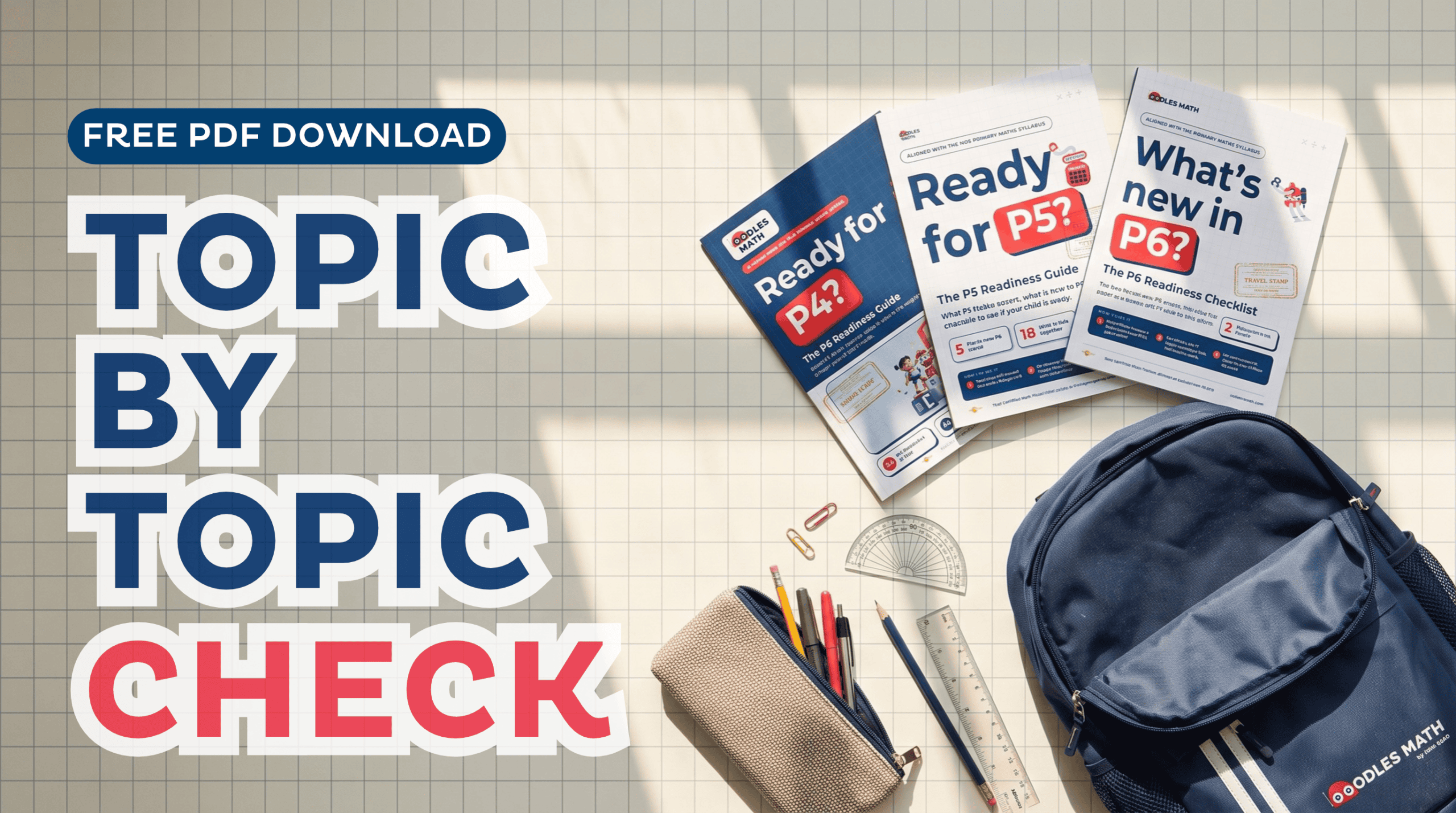
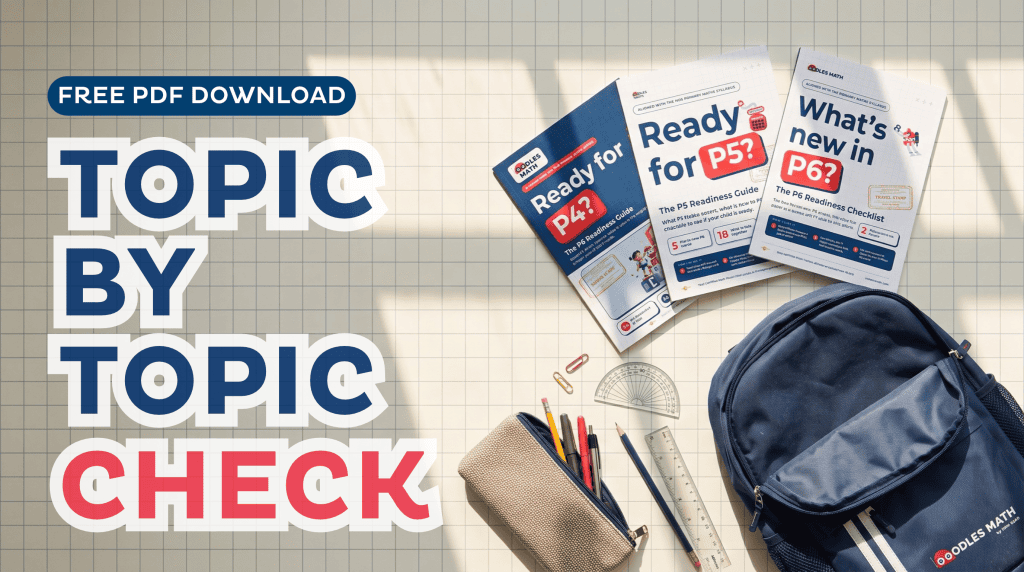
One free PDF with all three readiness guides, so you have a map for every move from P3 to P6.
What is inside
Ready for P4?
End of P3. What P3 maths covers, what is new in P4, and a checklist to tick together.
Ready for P5?
End of P4. Your child’s P4 maths at a glance, what changes in P5, and a checklist.
What's new in P6?
End of P5. The four brand-new P6 topics, the 2026 PSLE paper at a glance, and 17 skills to tick together.
Get the Level-Up Pack
Free PDF. All three guides in one download.
Your details are handled under our Privacy Policy.
Questions parents ask
When should I check if my child is ready for the next level?
The November and December holidays are a calm time to do it. There is no exam pressure, and you have a few weeks to close any gaps before the new year starts.
Does every school teach topics in the same order?
No. The topics are the same because they come from the MOE Primary Mathematics Syllabus (2021), but the order can differ by school. Use the guides as a map of what the year covers, and check your child’s scope letter for the exact timing.
What if my child has a few gaps on the checklist?
That is common and easy to work on. Practise little and often, and start with the lines you could not tick. A free trial class is another way to find out which topics need a little more time.
Do I need to be good at maths to use the checklists?
No. Every line comes with a worked example, so you can try it together and see whether your child gets the same answer.
See where your child stands
Book a free trial class. Your child joins a real lesson with our coaches, and you will hear which skills on the checklist are solid and which to work on before the new year starts.
+15 to 20 marks on Paper 2 is typical for students who learn our strategies: around one AL grade.
Sole Certified Math Tuition Partner of onSponge since 2010
Sources: MOE Primary Mathematics Syllabus (2021); SEAB, PSLE Mathematics (0008).