


Full Subject-Based Banding, explained for primary parents
What Your Child's PSLE Math Grade Decides About Secondary School
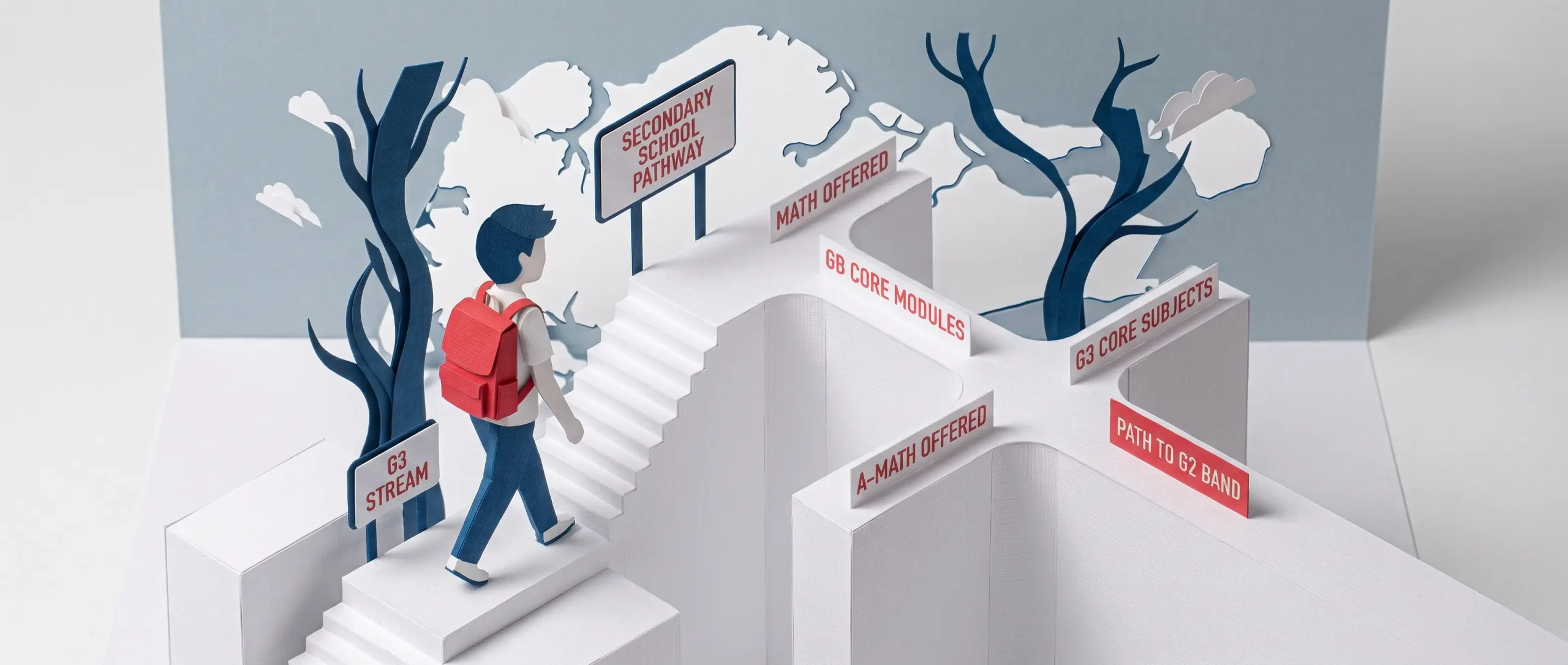
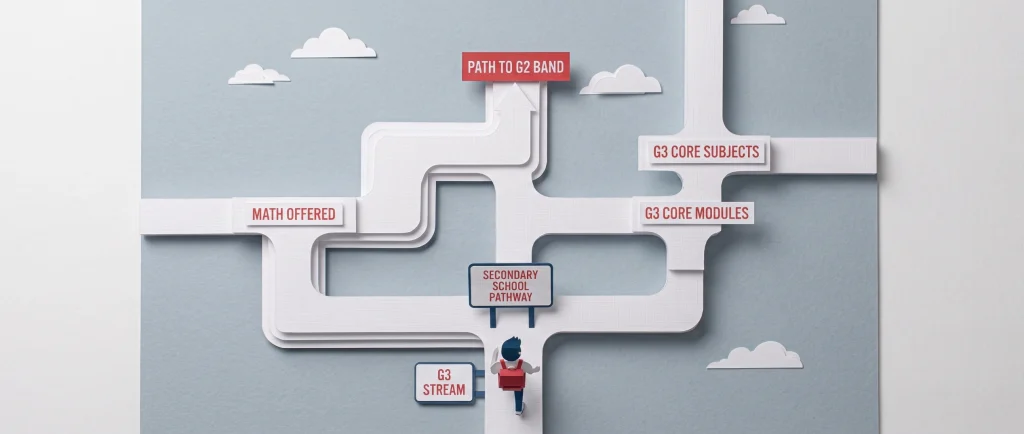
Under Full Subject-Based Banding, your child’s Mathematics result is looked at on its own. An AL 5 or better in PSLE Mathematics means your child can take Maths at G3 from the first day of Secondary 1, even when their overall PSLE score places them in Posting Group 2. The Maths grade opens that door by itself.
Since 2024, the Express, Normal (Academic) and Normal (Technical) streams no longer exist. Students are posted to secondary school through Posting Groups 1, 2 and 3, and take each subject at one of three levels: G1, G2 or G3, where G simply stands for General. G3 sits at the former Express standard, G2 at Normal (Academic), G1 at Normal (Technical).
For a parent of a Primary 4, 5 or 6 child, one part of this matters more than the rest. Your child is no longer placed into a single band for everything. Maths is assessed as its own subject, with its own grade and its own door.
This is the part most parents only discover after their child has already started Secondary 1. Subject levels can be adjusted, and the system is genuinely designed to allow it. But the reviews happen at set points, usually at mid-year and year-end in Secondary 1 and Secondary 2, and the places available at the higher level are limited. By Secondary 3, when subject combinations are locked in for the national examination, moving up is rare.
The good news is that the easiest moment to secure G3 Maths is before secondary school begins at all. It is decided by one number on the PSLE result slip.
How the PSLE score maps to a Posting Group
Your child’s four subject ALs add up to an overall PSLE score. That score decides the Posting Group, which guides the level most of their subjects start at in Secondary 1.
| PSLE Score | Posting Group | Most subjects start at |
|---|---|---|
| 4 to 20 | Posting Group 3 | G3 |
| 21 to 22 | Posting Group 2 or 3 | G2 or G3 |
| 23 to 24 | Posting Group 2 | G2 |
| 25 | Posting Group 1 or 2 | G1 or G2 |
| 26 to 30, with AL 7 or better in English and Maths |
Posting Group 1 | G1 |
| PSLE Mathematics result Score | Maths can be taken at |
|---|---|
| AL 5 or better (Standard Maths) | G3 or G2 |
| AL 6 (Standard Maths) | G2 |
| AL A (Foundation Maths) | G2 |
A student with an overall PSLE score of 23 is admitted through Posting Group 2 and takes most subjects at G2. If that same student scored AL 5 for Mathematics, they can take Mathematics at G3 from the start of Secondary 1.
So two children can walk into the same Secondary 1 classroom with the same overall PSLE score, and only one of them is doing G3 Maths. The difference is not the total. It is the Maths AL.
This is also more common than parents expect. For the 2025 Primary 6 cohort, around 65% of students eligible for Posting Groups 1 and 2 were able to take at least one subject at a more demanding level.
Where the AL 5 boundary actually sits
Because the door opens at AL 5, it is worth seeing the marks behind the grades.
| Achievement Level | Marks |
|---|---|
| AL 1 | 90 and above |
| AL 2 | 85 to 89 |
| AL 3 | 80 to 84 |
| AL 4 | 75 to 79 |
| AL 5 | 65 to 74 |
| AL 6 | 45 to 64 |
| AL 7 | 20 to 44 |
| AL 8 | Below 20 |
A child sitting in the upper part of AL 6 is not far from AL 5. In many cases the gap is a handful of marks, and those marks tend to sit in the same place every year: Paper 2 problem sums, where a child either recognises what the question is asking or freezes.
Students who learn our strategies typically gain 15 to 20 marks on Paper 2, which is around one AL grade. That is not a promise of top in class. It is what genuine understanding tends to do, and at the AL 6 to AL 5 boundary it is exactly the range that decides whether G3 Maths is on the table.
Why the primary years now carry more weight
Nothing about this should feel like pressure. It is simply a shift in when the useful work happens. Under the old streaming system, a child’s secondary path was largely set at PSLE and difficult to change. Under Full SBB the path can change, but the moments where it changes are few, and the first one is the widest by far.
That first moment is the PSLE Mathematics grade. Which means the work that decides it happens in Primary 4, 5 and 6.
Our +thinkingMath programme is built for exactly those years.
- ACEit, so problem sums finally make sense. “I understand the words, but I don’t know how to solve it” is the most common thing we hear. ACEit is our reading method: your child learns to take a word problem one sentence at a time and turn it into a picture they can work with. Reading to understand, not just reading to read.
- A strategy for each question type. The marks that decide a grade usually hide in Paper 2 problem sums. We have sorted those questions into types and matched each one to a clear strategy, so instead of freezing your child reaches for the right approach. If one does not fit, they have another.
- Aligned to the MOE syllabus. Same topics, same sequence as school. Your child is never learning a separate tuition version of maths.
- Understanding that holds up under exam conditions. No shortcuts. Real objects, then pictures, then numbers, and a simple routine for approaching any problem: Understand, Plan, Solve, Check.
- Eyes on every child, every lesson. Teachers check understanding live in class rather than at the end of term, so a wobble is spotted and fixed while it is still small.
What happens if your child starts at G2 Maths
It is not a closed door, and it should not be read as one. A child who does well at G2 Maths can be offered G3 at a later review point, and many are. Two things are simply worth knowing early.
The reviews happen at set junctures, generally at mid-year and year-end in Secondary 1 and Secondary 2, and they are decided by each school based on sustained performance and a teacher’s recommendation. Places at the higher level are limited, which is where that figure of around the top 5% of a subject cohort comes from. By Secondary 3, once subject combinations are set for the national examination, movement between levels becomes uncommon.
None of that is cause for worry. It just means the calmest version of this is the one where the door is already open on day one.
A note on the 2027 examination change
From 2027, the O-Level and N-Level certificates are replaced by a single Singapore-Cambridge Secondary Education Certificate, or SEC. The 2024 Secondary 1 cohort reaches Secondary 4 in 2027, which is why that year is the first SEC year.
The important reassurance for a primary parent is that the syllabus content does not change. What changes is the name of the certificate and the way each subject is recorded, with the G level shown alongside it. G3 sits at the former O-Level standard, G2 at the former Normal (Academic) standard.
See where your child stands in Maths
Every child can do this. Most just need the right approach, the right strategies, and a teacher who notices. Come and see what that looks like in a +thinkingMath class, and we will show you honestly where your child is with Paper 2.
FAQ
What PSLE Maths grade does my child need for G3 Maths?
An AL 5 or better in Standard Mathematics allows your child to take Mathematics at G3 or G2 from the start of Secondary 1. An AL 6 in Standard Mathematics, or an AL A in Foundation Mathematics, allows Mathematics at G2.
Can my child take G3 Maths if they are in Posting Group 2?
Yes. Students posted through Posting Group 1 or 2 may take English, Mother Tongue, Mathematics and Science at a more demanding level from the start of Secondary 1, based on their Achievement Level in that subject. A student with an overall PSLE score of 23 who scored AL 5 in Mathematics takes most subjects at G2 but can take Mathematics at G3.
Can my child move from G2 to G3 Maths after Secondary 1 starts?
Yes, but it is not automatic. Schools review subject levels at set points, generally at mid-year and year-end in Secondary 1 and Secondary 2, based on sustained performance and a teacher’s recommendation. Places are limited and criteria vary by school, with many looking at around the top 5% of the cohort at that subject level. Movement becomes uncommon from Secondary 3 onwards.
What is the difference between G1, G2 and G3?
They are three subject levels that replaced the old streams. G3 sits at the former Express standard, G2 at Normal (Academic) and G1 at Normal (Technical). Your child takes each subject at the level that suits them, so they can be at G3 for one subject and G2 for another.
is my child locked into their Posting Group for four years?
No. The Posting Group guides the level most subjects start at in Secondary 1. It is not printed on the final certificate and it does not fix subject levels for the whole of secondary school.
Does the 2027 SEC change what my child has to learn?
No. From 2027 the O-Level and N-Level certificates are replaced by a single Singapore-Cambridge Secondary Education Certificate. The syllabus content stays the same. What changes is the certificate and the way each subject is recorded, with its G level shown alongside.
When should we start preparing for this?
The decision point is the PSLE Mathematics grade, so the work that matters happens across Primary 4, 5 and 6. The marks that move a child across an AL boundary usually sit in Paper 2 problem sums, which is where our strategies are focused.
Sources: Ministry of Education, Secondary school experience under Full SBB, and the PSLE-FSBB FAQ; Singapore Examinations and Assessment Board, release of 2025 PSLE results. Subject-level review criteria are set by individual schools and vary. Cut-off points and criteria change from year to year, so confirm current details with MOE or your child’s school.
Last reviewed: 11 September 2026


For OM Students
Join us
Exclusive Education Partner